
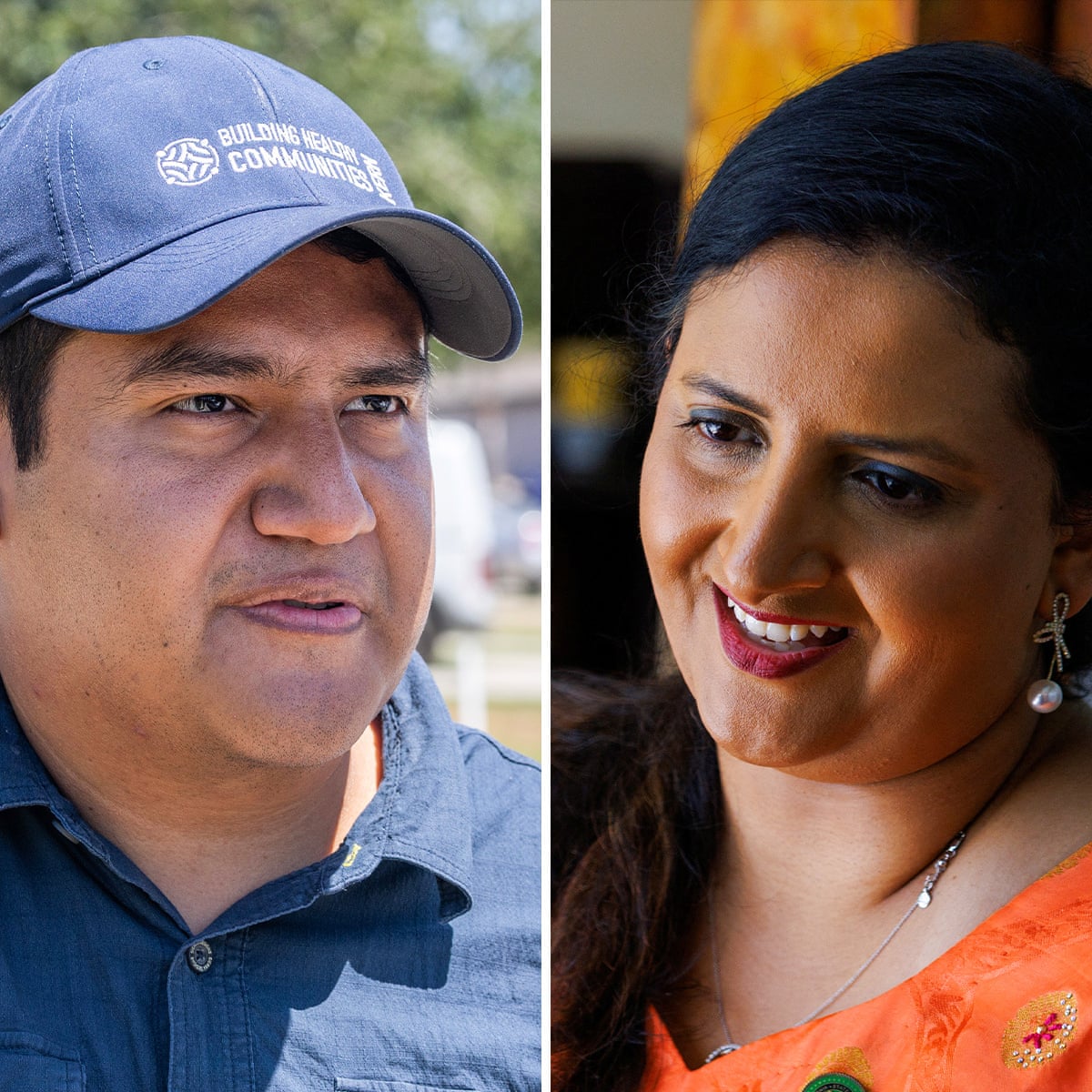
Democrats are determined to flip the 22nd district blue. But which vision for the future will prevail? When Jasmeet Bains first announced she was running for Congress, some Democratic powerbrokers saw her candidacy as downright providential in their quest to flip a crucial House seat that had been in Republican hands for years. As a doctor in California’s agriculture-heavy Central valley, living and working in one of the poorest districts in the US, Bains could speak with singular authority about the devastating impact of cuts to healthcare enacted in Donald Trump’s One Big Beautiful Bill Act.
Her scrubs and white doctor’s coat were a powerful visual reminder that the district’s longtime incumbent congressman, Republican David Valadao, had cast one of the bill’s deciding votes last summer. Every time she pulled a shift at a community clinic in her home town – something she continued to do on weekends even as a member of the state legislature – she saw first hand how the loss of government coverage threatened to devastate hundreds of thousands of district residents and their children. Add to that a compelling personal narrative – she is the daughter of Sikh refugees and the first Asian American to serve in the California assembly – and an independent streak that has occasionally infuriated her own party leadership, and Bains appeared to be the complete package for a seat the Democrats cannot afford to lose in November’s midterms. “She’s fighting for our lives, our kids’ healthcare, and home care our seniors need to thrive,” the powerful Service Employees International Union said in an endorsement on the day Bains entered the race last summer.
The seat has only grown in importance now that California has redrawn its congressional district boundaries in response to a wave of Republican gerrymandering in Texas, making it easier for Democrats to pick up as many as five extra House seats in the state. Instead of laying out a glide path to victory, however, the Democrats have become mired in a singularly nasty fight over their identity as a party, with Bains thrust squarely into the middle of it. What Bains’s excited backers overlooked – or chose to ignore – was that a promising Democrat was already campaigning for the seat, and building his own cadre of enthusiastic backers. Randy Villegas, a 31-year-old community college professor and second-generation Mexican immigrant, had been crisscrossing the district laying out his theory of the race in an area that is 75% Latino and has a median voter age of just 30.
Bains, he argued, did not represent any kind of solution because he saw her as a big part of the problem. As a community organizer who had written a doctoral thesis on the low voter turnout rate among young Latinos like him, Villegas saw a groundswell of disillusionment with both major parties and believed it was time for a candidate who could address the struggles of young people and working families without caving to the oil, agriculture and pharmaceutical interests that drive the local economy. The problem with Bains and other candidates before her, Villegas has argued, is that blunt their own best talking points, on healthcare and many other subjects, and thus alienate the people most in need of effective representation. That, he says, is why a district where Democrats enjoy a significant advantage in registration and routinely outvote Republicans in statewide and presidential elections had voted Valadao out just once in the last 14 years – and then only for a single term.
“We need to work to expand the electorate,” Villegas said in an interview. “For too long, Democrats have run Republican-lite campaigns … We can’t just offer that we’re not Trump. We have to stand for something.” The two Democrats are now locked in a ferocious battle ahead of a 2 June primary that will determine which of them faces Valadao in the general election in November. In many ways, the battle over California’s 22nd congressional district reflects a broader nationwide struggle between the Democratic party’s moderate and progressive wings.